The Dashboard Every Learning Leader Should Have
Discover the six Knowledge Intelligence metrics every Learning Leader needs to improve readiness, close knowledge gaps and measure business impact.
Corporate learning has never been more important. Organisations are expected to launch increasingly complex products, adapt to evolving regulations, accelerate digital transformation and equip employees with new capabilities at an unprecedented pace. At the same time, executives are under growing pressure to prove that investment in learning translates into measurable business outcomes, not simply higher participation.
Yet the way most organisations evaluate learning has barely changed in a decade. Completion rates, training hours, learner satisfaction and assessment scores still dominate executive reports. These indicators describe programme execution, but they say almost nothing about the one question that actually matters:
Do employees possess the knowledge required to perform successfully when it matters most?
The distinction is not academic. Measuring whether training was delivered is not the same as measuring whether organisational capability is improving, and in competitive markets the second is far more valuable.
The limit of activity metrics
Traditional dashboards were built to monitor programmes, not performance. They answer operational questions: how many people completed the course, how many hours were delivered, how satisfied participants were. That visibility is useful, but it collapses the moment an executive has to decide whether the field force is ready to launch, whether a compliance risk is contained, or whether a team can defend its quota.
A sales organisation can report 98% completion on product training and still deliver inconsistent messaging in customer conversations. A pharmaceutical company can certify its field force before a launch while critical scientific misconceptions sit concentrated in specific territories. A compliance programme can hit near-perfect attendance while people keep repeating the same procedural errors months later.
The problem is not that employees failed to complete the training. It is that completion was mistaken for competence. Our own benchmark makes the gap concrete: across a December 2025 study of 90 Life Sciences companies and 21 million questions answered, teams relying on their existing learning stack sat at around 72% average knowledge on key topics. The remaining 28% is invisible, and it is expensive.
Knowledge is dynamic, so dashboards should be too
Knowledge does not hold still. Every product update, competitive launch, regulatory change, clinical publication or pricing adjustment creates new requirements across the organisation, while the forgetting curve quietly erodes what people already learned. What a team knew three months ago is already partly obsolete.
So learning is not a sequence of isolated events. It is a continuous cycle of identifying, reinforcing and validating what people know. That calls for a different analytical model: instead of measuring activity, measure how capability evolves; instead of reporting attendance, show where knowledge is weakening; instead of assuming everyone needs the same reinforcement, pinpoint exactly which people, teams or topics carry the highest business risk.
This is the shift from learning reporting to Knowledge Intelligence.
The six metrics every learning leader should monitor
A modern dashboard should reveal what people know, what they have forgotten, and where to intervene. The names below map directly to the indicators a Knowledge Intelligence platform tracks.
1. Knowledge Gap Rate
Every wrong answer is a signal, but not every mistake carries the same business consequence. What matters is seeing which concepts, products, processes or messages concentrate the most errors. Roughly 20% of questions are critical and hold about 80% of the value, so isolating those critical gaps, rather than reporting an assessment average, is where prioritisation starts. In our dataset this surfaces around 16 critical gaps per commercial rep per year.
2. Knowledge Retention
Knowledge should not be measured the moment a course ends. The real question is whether people retain critical concepts days or weeks later, when they have to use them. Tracking retention against the forgetting curve is a far more honest indicator of readiness than an end-of-course score.
3. Knowledge Evolution
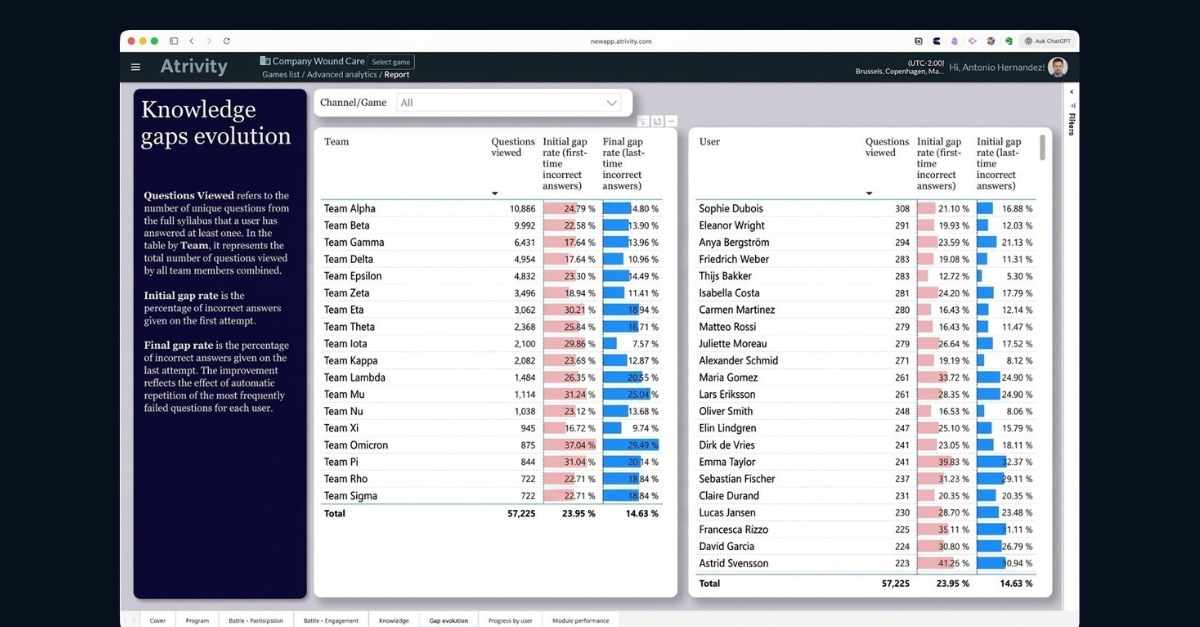
Learning only counts if it improves over time. Comparing a knowledge baseline against later cycles separates a temporary bump from genuine acquisition, and shows whether reinforcement is actually reducing gaps or just adding activity. Done well, this is where a programme can demonstrate a measurable 18 to 20 point lift over the baseline.
4. Gap Resolution
Finding gaps is worthless unless they close. The dashboard should track how many critical gaps have been resolved, how fast remediation happens, and which gaps remain open. Automated remediation that validates closure (for example, confirming mastery only when a user answers 4 of 5 follow-up questions correctly) turns analytics into an operational tool rather than a historical report.
5. Performance Readiness
Executives rarely ask whether people completed their training. They ask whether their teams are ready. A readiness index combines product, competitor, objection-handling and technical or clinical knowledge into a single view of whether employees can perform with confidence in real situations. It moves the conversation from educational activity to business preparedness.
6. Business Impact
This is the metric that changes the discussion, and it deserves more weight than the other five. Knowledge has economic consequences: misjudging a competitive differentiator loses deals, incorrect product information erodes customer confidence, compliance errors create regulatory exposure, technical misunderstandings generate inefficiency. Knowledge Intelligence puts a number on it. Using a value-per-gap framework, each critical gap can be tied to the revenue it puts at risk, typically between EUR 500 and EUR 10,000 per rep per year. A single 70-rep sales force can carry around EUR 2 million in revenue leakage hidden behind gaps no completion report would ever show. Framing knowledge this way, as verifiable evidence with a price attached, is what lets a learning leader walk into an executive meeting and size the prize, not just report attendance.
From learning dashboards to Knowledge Intelligence
The biggest shift here is conceptual, not technological. For years dashboards described what happened during a programme. The next generation predicts where performance problems are about to emerge.
Instead of asking "how many employees completed the course?", learning leaders should be asking:
- Which critical knowledge gaps remain unresolved?
- Which teams are most exposed to knowledge risk?
- Which topics need immediate reinforcement?
- How has knowledge evolved since the last cycle?
- What business impact could the unresolved gaps generate?
These questions reposition Learning & Development as a strategic contributor to performance rather than an operational support function.
A complement, not a replacement
None of this means abandoning the LMS or LXP. Those systems are good at what they were built for: delivering and administering content at scale. Knowledge Intelligence sits alongside them and does the part they were never designed to do, measuring what actually landed and closing the gaps that remain. Completion rates, satisfaction surveys and attendance figures keep their place as indicators of programme delivery. They should simply stop being mistaken for evidence of capability.
The organisations that outperform tomorrow will not be the ones that deliver the most training. They will be the ones that understand what their people know better than anyone else, spot emerging gaps continuously, and act before those gaps turn into business problems.
Ready to Close the Gap Between Learning and Performance?
Discover how global organisations use Atrivity to turn knowledge into measurable business outcomes.
Try a Demo