How to Upgrade Your LMS: From Course Completion to Business Impact
Upgrade your LMS beyond course completion with microlearning, knowledge intelligence, AI-powered learning, and measurable business impact.
Learning Management Systems have become essential to the modern learning ecosystem. They give organisations a central place to deliver training, manage learning paths, assign courses, track participation and keep a record of employee development. For many companies, the LMS is where the learning journey begins and ends.
But one question deserves more attention: what happens after an employee completes a course?
Completion is easy to measure. Learning is much harder. An employee can finish a product course, pass the assessment and earn a certificate, yet struggle to recall the information weeks later. A sales rep can complete onboarding without feeling confident about a new product. A compliance course can hit 98% completion while employees still misunderstand the most important policies. And in many industries, those gaps are not just an L&D problem. They become a business problem.
The LMS is the foundation, not the finish line
An LMS does an excellent job of managing structured learning. It gives L&D teams the infrastructure to organise content, build learning paths, assign training, manage certifications and confirm whether people complete what is assigned. That infrastructure is essential, especially for large organisations with thousands of employees across multiple markets.
The challenge comes when completion becomes the main indicator of success. A dashboard might tell you 95% of employees completed a course. It doesn't tell you how much they remember, which concepts they actually understood, or where they are still struggling. An LMS gives you a clear picture of learning activity without giving you a complete picture of knowledge. And knowledge is what employees carry into the real world.
Across a December 2025 benchmark of 90 Life Sciences companies and 21 million questions answered, teams relying on their existing stack sat at around 72% average knowledge on key topics. The missing 28% is invisible on a completion report, and it is where the risk lives.
When knowledge gaps become business gaps
Picture a sales rep walking into an important meeting. They have completed the product training and read the latest materials. The LMS shows them as fully trained. During the visit the customer asks a technical question and the rep hesitates. Maybe they forgot a specification, confused two similar features, or failed to handle a key objection because the information wasn't there when they needed it.
That is not a lack of effort. It is a knowledge gap, and when it appears at the wrong moment it can change the outcome. The rep sounds less sure, the customer's trust dips, an opportunity slips. In technical and regulated sectors such as pharmaceuticals, medical technology and life sciences, where reps must communicate complex, constantly evolving information, the consequences are larger still, and a rep who gives outdated or incorrect information creates a real problem, not just a missed sale.
So the business question is not whether someone completed a course. It is: does the employee know what they need to know when they need to use it? Being trained is not the same as being ready.
Completing training doesn't mean remembering it
Most of us have lived this. You finish a course, the information feels familiar, you feel confident. A few weeks pass and some of it is simply gone. Knowledge decays when it isn't reinforced or retrieved, and the problem grows when people have to absorb a lot in a short time, exactly what launches, onboarding, compliance and technical training demand.
So the end of a course shouldn't be the end of the learning experience. The goal isn't to make sure employees were exposed to information. It's to make sure they can still access and use it when it matters.
So how do you upgrade an LMS?
Not with another platform full of more courses. You build a stronger ecosystem around the LMS you already have.
The shift is to think beyond the course. Once a programme is complete, the key concepts should be reinforced through short, regular interactions: a quick question on a product feature, a compliance scenario, a challenge on something covered in onboarding, a refresher before a customer meeting. These let people retrieve and reinforce knowledge without sitting through a whole module again. This is where microlearning earns its place: instead of another 20 or 30 minutes in a course, reinforce the most important concepts in short bursts that fit the work day. Learning should adapt to the employee's workflow, not hinder it.
Learning doesn't always need a screen
This is why mobile learning matters for field and distributed teams. A rep travelling between meetings might have twenty minutes in the car, a wait at the airport, a few minutes before a meeting. Too short for a traditional module, long enough to reinforce one concept.
Atrivity's AI-Gen Podcasts were built exactly for this. Existing company content (presentations, PDFs, technical documentation, product information) is turned into short, conversational audio episodes that can be consumed without a screen. A pharmaceutical rep driving to a visit can listen to a short conversation about a product update, a scientific concept or how to handle a specific objection, instead of opening a course.
And it doesn't stay passive. The podcasts pair with quizzes in the mobile app, so employees test their understanding after listening, and the results feed the wider picture of what they know and where they need reinforcement. That is learning in the flow of work: not another meeting or module, but small moments embedded in the day.
From activity to knowledge, and from knowledge to gaps
There is a real difference between consuming information and being able to recall it. Watching a video or listening to a podcast creates familiarity. Answering a question, making a decision or solving a scenario forces active retrieval. The LMS can confirm a team completed the new-product training. A short question a few days later reveals whether they actually remember the differentiators. So the more useful question becomes not "did they complete the training?" but "can they recall and apply it?"
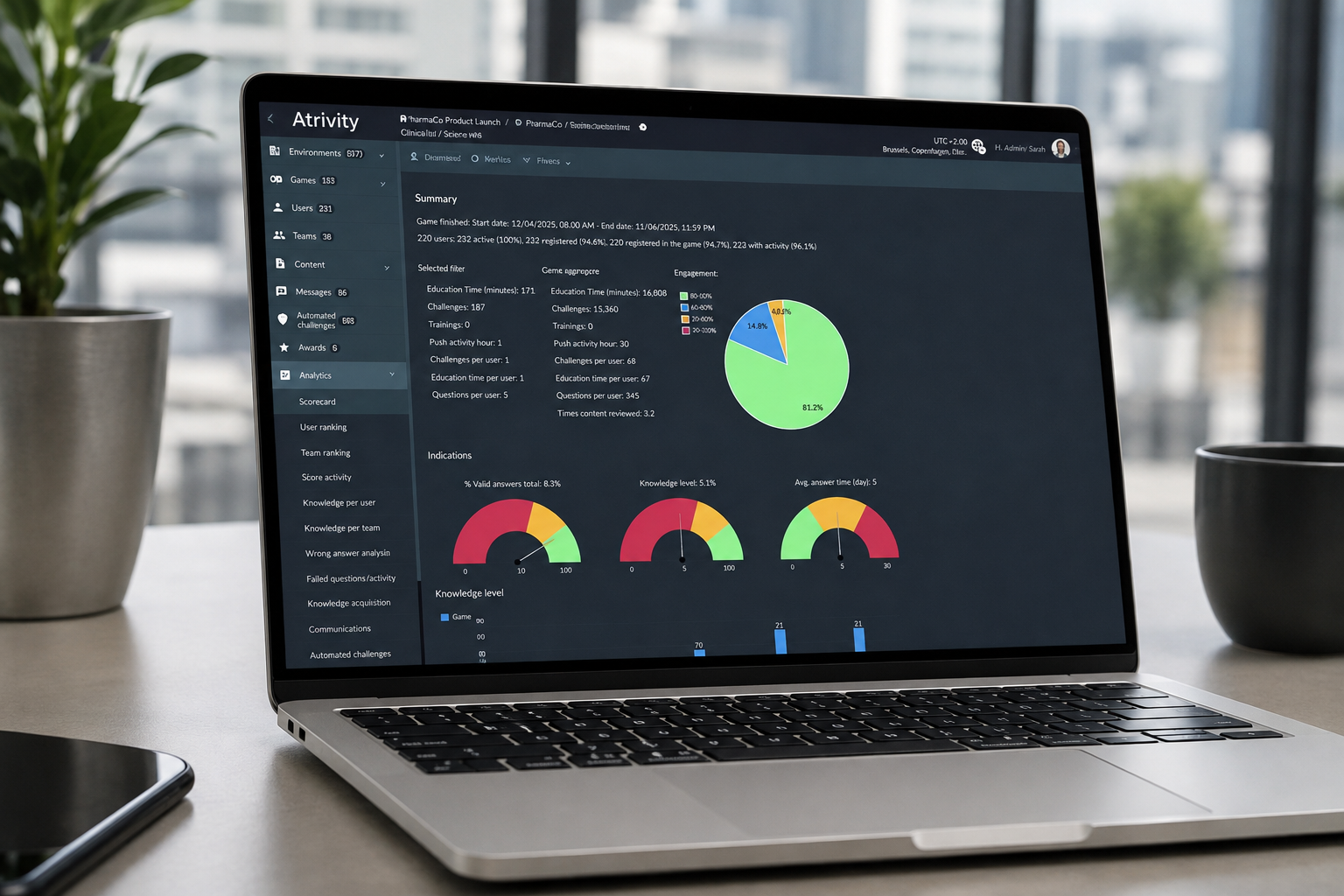
Once you measure knowledge rather than activity, a further opportunity appears: not everyone has the same gaps. One rep knows the product well but struggles with pricing; another has the pricing but forgets the key use cases. Completion rates and overall scores hide this. Atrivity's Knowledge Intelligence approach analyses learner responses to pinpoint where gaps sit across individuals and teams, giving L&D a granular view of what people know, where they struggle and how that changes over time.
Reinforcement should be targeted
Finding a gap only helps if you can act on it, and sending someone back through an entire course is rarely the answer. They may already know 90% of it. What they need is reinforcement on the 10% they haven't retained. This is Atrivity's Gap Fixing: through gamified microlearning, knowledge challenges and intelligent repetition, it reinforces the concepts that matter and confirms closure only when the learner answers 4 of 5 follow-up questions correctly. The loop is simple and continuous: identify the gap, reinforce it, test again, measure improvement. The aim isn't more learning activity. It's closing the gaps that affect performance. In our data, a typical rep shows around 16 critical gaps a year, and this reinforcement layer lifts knowledge a measurable 18 to 20 points above the LMS baseline.
From knowledge data to business impact
This is the biggest opportunity in upgrading learning technology. For years L&D has been asked to prove impact with completion, attendance, training hours and satisfaction. Those have their place, but leaders want to know something else: what did the training change?
If a rep is more confident explaining a complex product, that matters. If a team communicates a new proposition consistently across markets, that matters. If employees are less likely to give customers wrong information, or a new hire reaches product fluency faster, that matters. Knowledge isn't an abstract HR metric. It's connected to revenue, customer experience, risk and operational performance.
Atrivity is built to make that connection visible, and to put a number on it. Each critical gap can be tied to the revenue it puts at risk, typically between 500 EUR and 10,000 EUR per rep per year, so a single 70-rep sales force can be carrying around 2 million EUR in leakage hidden behind gaps no completion report shows. That moves the conversation from "95% completed the training" to "we identified the gaps affecting our teams, reinforced them, measured the improvement, and sized what it was worth to the business." That is where learning becomes a business lever rather than an operational requirement, and it matters most in technical and regulated industries, where accuracy and credibility in front of the customer are part of the commercial strategy.
LMS + Atrivity: better together
Atrivity is not an alternative to the LMS. The two solve different parts of the problem. The LMS is the infrastructure for structured learning: courses, content, paths, completion. Atrivity adds the layer around it: knowledge measurement, engagement and reinforcement that show what people retained, where the gaps are, and how to close them through gamified microlearning, mobile learning and AI-Gen Podcasts.
In practice they work together naturally. An employee completes a product course in the LMS. A few days later Atrivity reinforces the key concepts with a short challenge or a podcast. Their responses reveal where knowledge is strong and where it isn't, the weak areas get reinforced, and improvement keeps being measured. The LMS delivers the learning. Atrivity helps make it stick, and makes the impact measurable.
You don't need to replace your LMS. You need to upgrade it.
For organisations that have already invested heavily in an LMS, the next step isn't replacement. It's adding the capabilities the traditional learning experience is missing: continuous reinforcement, Knowledge Intelligence, gamified microlearning and new ways to consume learning such as AI-Gen Podcasts. Your LMS stays as the place where structured training is delivered and managed. Atrivity covers what happens beyond the course, so the experience doesn't stop when someone clicks "complete".
Because the goal isn't simply to deliver more training. It's to make the training you already invest in more effective, and to connect learning to the knowledge and performance your business depends on.
Ready to Close the Gap Between Learning and Performance?
Discover how global organisations use Atrivity to turn knowledge into measurable business outcomes.
Try a Demo