Screenless Learning: Why Workplace Learning Is Moving from Training to Conversation
Discover how AI, gamification, and conversational learning are transforming workplace learning, improving knowledge retention and employee performance
For decades, workplace learning followed a predictable model.
Employees were expected to stop what they were doing, log into a platform, find content, complete training, and return to work.
That model made sense when learning was primarily about structured content delivery.
But work has changed.
Customer-facing teams operate under pressure. Product knowledge evolves constantly. Decision-making happens in real time. Employees are already overwhelmed by dashboards, notifications, platforms, and information overload.
And Artificial Intelligence (AI) is accelerating a shift many organisations still underestimate: workplace learning is moving from screen-based training to conversational performance support.
Not "screenless" in the literal sense, but screenless in behavioural terms. Learning that no longer feels like entering a training system. Learning that feels like simply asking for help.
And that shift could fundamentally change how organisations think about knowledge management, employee readiness, and workforce performance.
The Problem with Traditional Workplace Learning
Most enterprise learning technology was designed around a simple assumption: employees will intentionally go somewhere to learn.
That worked when learning was formal, scheduled, and event-based. But in modern operational environments, that assumption creates friction, because real performance moments rarely look like traditional training scenarios.
A sales rep preparing for an important client meeting does not want a 40-minute e-learning module. A retail employee serving a customer does not want to search through a learning management system (LMS). A customer service agent handling a live issue does not want to leave their workflow to find documentation.
They need immediate support, fast answers, and trusted guidance.
This is where traditional employee training experiences begin to fail. As Fosway notes in its 2026 analysis:
"The assumption that all learners are desk-based knowledge workers with time on their hands discovering new skills and career opportunities is patently false."
That observation matters because many corporate learning platforms were designed around behaviours that simply do not reflect how frontline employees and customer-facing teams actually work.
The issue is no longer access to content. The issue is the distance between knowledge and execution.
What Screenless Learning Actually Means
Screenless learning is easy to misunderstand. It does not mean removing devices. It means removing friction.
Traditional digital learning often follows this sequence: need information, go to learning platform, search, consume content, return to work.
Screenless learning flips the model: need support, ask, receive guidance, act.
That support might come through AI assistants, embedded coaching, adaptive learning, knowledge reinforcement, conversational practice environments, or audio-based learning experiences.
The technological format matters less than the behavioural shift. Learning stops being a destination. It becomes part of work itself.
Learning Is Becoming Conversational
This is arguably the most important shift.
For years, corporate training was built around passive consumption: watch this, read this, complete this, pass this. But AI is changing expectations. People increasingly expect technology to behave conversationally. They do not want to navigate systems. They want answers.
Imagine an employee asking:
"How should I position this product against a competitor?"
"Test me before my customer meeting."
"What's the approved response to this objection?"
That is fundamentally different from traditional training. This is not content delivery. This is active performance support and sales enablement.
Fosway points directly toward this shift:
"The traditional front door to learning will evolve into something more conversational and adaptive, with AI coaches guiding learners in real time rather than presenting curated content tiles."
That changes everything. Once learning becomes conversational, employees no longer need to "visit learning." Learning comes to them.
This Is Not About Convenience. It Is About Performance.
It would be easy to dismiss this as a UX trend. That would be a mistake.
The real business problem is not content availability. It is execution quality.
Organisations do not struggle because employees lack access to information. They struggle because knowledge fades before performance moments arrive. This shows up everywhere: inconsistent sales messaging, poor objection handling, slow employee onboarding, product knowledge decay, frontline mistakes, and lack of confidence in customer interactions.
The problem is not necessarily that employees never learned the material. The problem is that they cannot reliably apply it when it matters.
This is where gamification, microlearning, and spaced repetition change the equation.
By combining game-based learning with structured repetition, organisations can counteract knowledge decay systematically. Instead of a single training event followed by gradual forgetting, employees encounter the right knowledge at the right moment, in short bursts that fit naturally into their working day.
The result is stronger knowledge retention, higher confidence, and better execution in real customer interactions.
That changes the learning conversation entirely, because retention matters more than completion, reinforcement matters more than content libraries, and performance enablement matters more than static training repositories.
Why Audio May Become a Major Part of This Shift
One of the most overlooked dimensions of screenless learning is audio.
Employee behaviour is already changing. People increasingly consume information through podcasts, voice notes, AI voice assistants, audio summaries, and conversational media.
Workplace learning will inevitably follow the same pattern.
But this is no longer just a prediction. AI already makes entirely new learning formats possible.
Instead of forcing employees to read static content, organisations can now transform knowledge into AI-generated learning experiences that fit naturally into the flow of work.
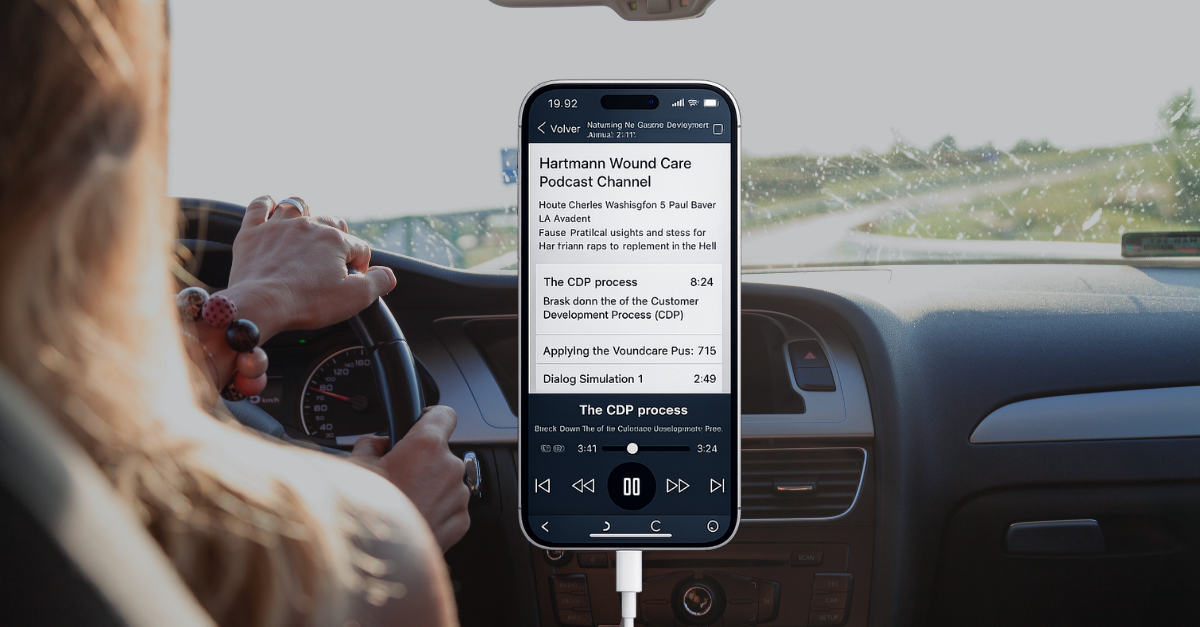
That means onboarding training delivered as conversational audio, product updates employees can listen to between meetings, reinforcement training consumed during commutes or downtime, and objection handling scenarios delivered through interactive voice experiences.
This dramatically reduces friction.
Employees no longer need to stop what they are doing, log into a platform, search for content, and navigate through modules.
Learning becomes continuous, contextual, and consumable anywhere.
Atrivity's AI-generated learning podcasts are a concrete example of what this looks like in practice: corporate knowledge transformed into engaging audio experiences that employees actually consume, whether they are in the field, between meetings, or commuting.
The format removes the login barrier entirely and makes reinforcement feel less like training and more like staying informed.
This is especially relevant for distributed teams, field sales teams, retail employees, and other frontline workers who rarely have uninterrupted time for traditional training.
Structured Learning Is Not Disappearing
This does not mean traditional learning goes away. Formal programmes still matter.
Structured learning remains essential for compliance, certification, deep capability development, collaborative programmes, leadership development, and regulated knowledge transfer.
This is not the death of structured learning. It is the evolution of learning and development (L&D) and performance enablement.
The future is hybrid: structured learning for depth, conversational support for execution.
The Strategic Implication for Business Leaders
The key question is not whether screenless learning is the future.
The real question is: which business problems does it solve better than traditional learning?
If your goal is simply managing training administration, the impact may be limited.
But if your challenge is faster employee onboarding, stronger knowledge retention, improved sales readiness, better product training, stronger customer service performance, or more confident customer conversations, the opportunity is much bigger.
Competitive advantage increasingly comes from reducing the gap between knowledge and action.
That requires more than making content available. It requires learning experiences employees actually engage with.
This is where gamification, reinforcement learning, conversational AI, AI-powered coaching, and AI-generated podcasts become powerful.
Employees do not want another dashboard, another portal, or another place to log in.
They want less friction, faster answers, smarter support, and learning that fits naturally into their workflow.
Ready to Rethink Workplace Learning?
If your teams need more than content delivery, if they need stronger knowledge retention, faster employee readiness, and better performance in real customer interactions, traditional training alone may not be enough.
Atrivity combines gamified learning, knowledge reinforcement, microlearning, sales enablement, and AI-generated learning podcasts so that learning is easier to consume wherever employees are: between meetings, commuting, or in the field.
If you want to see how it works in practice, book a demo or get in touch.
Ready to Close the Gap Between Learning and Performance?
Discover how global organisations use Atrivity to turn knowledge into measurable business outcomes.
Try a Demo