Knowledge as a Business Asset: Why Companies Should Measure Knowledge Like Revenue
Discover why workforce knowledge is a strategic asset and how AI-powered learning, knowledge retention, and gap analysis drive performance.
.png)
Every company tracks revenue.
They track pipeline, customer acquisition costs, employee productivity, and operational efficiency.
Yet one of the most valuable assets in the business remains largely invisible: workforce knowledge.
Organisations spend millions every year on training, onboarding, certifications, sales enablement programs, and learning and development technologies. But very few can answer a simple question:
What does our workforce actually know today?
The answer matters more than most leaders realise.
The Hidden Cost of Knowledge Gaps
Knowledge gaps don't appear on financial statements.
However, their impact is everywhere.
A sales representative who doesn't understand a new product feature loses opportunities.
A customer success manager who lacks product expertise struggles to drive adoption.
A frontline employee who misses a critical compliance update increases business risk.
The consequences are measurable:
- Lost revenue
- Longer sales cycles
- Lower customer satisfaction
- Increased operational errors
- Reduced employee performance
The problem isn't the lack of training.
The problem is the lack of visibility.
Most organisations measure learning activity rather than learning outcomes.
They know who completed a course.
They don't know who retained the knowledge.
Training Is an Expense. Knowledge Is an Asset.
Traditional corporate learning often treats knowledge as content.
Create content.
Deliver content.
Track completion.
Move on.
But knowledge is fundamentally different.
Knowledge influences decisions, behaviors, customer interactions, and business outcomes.
In other words, it generates value.
And anything that generates value should be managed as an asset.
Companies already manage financial assets, customer assets, and intellectual property.
Why not employee knowledge?
What Happens When You Start Measuring Knowledge?
Imagine a company could see its organisational knowledge in real time.
Not training completion.
Not attendance.
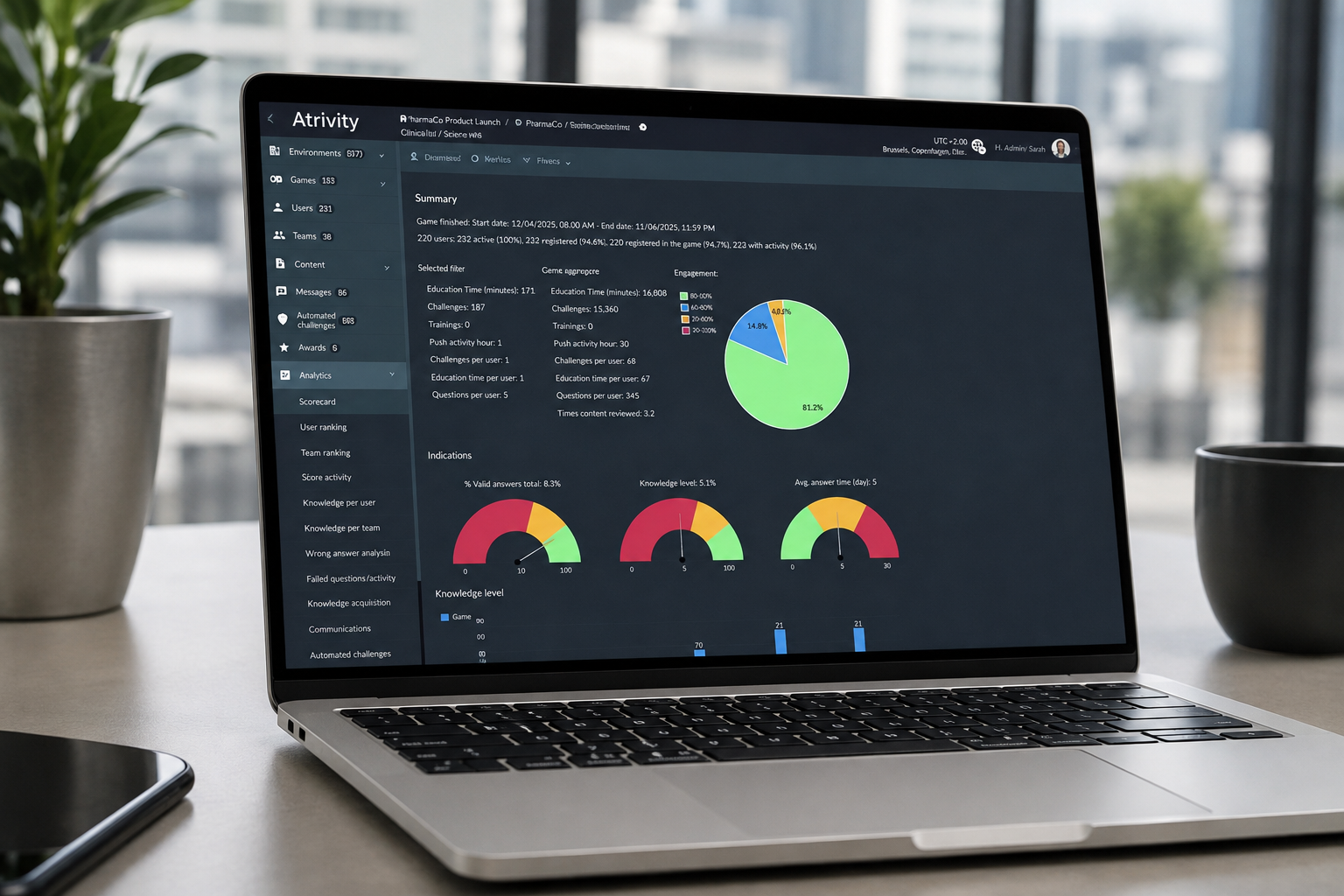
Actual knowledge levels.
Leaders could identify:
- Which teams are prepared to launch a new product
- Which regions have critical knowledge gaps
- Which salespeople are ready for strategic accounts
- Which employees need reinforcement before performance declines
Instead of guessing where to invest in learning, organisations could make data-driven decisions.
Knowledge would become measurable.
And once something is measurable, it becomes manageable.
The Link Between Knowledge and Business Performance
Research consistently shows that employee capability directly impacts business performance.
The challenge is that most organisations only see the outcome.
They see declining sales.
They see lower customer satisfaction.
They see reduced productivity.
What they don't see is the knowledge gap that caused it.
Knowledge is often the leading indicator.
Performance is the lagging indicator.
By the time poor performance appears, the knowledge problem has already existed for weeks or months.
Organisations that continuously measure employee knowledge gain the ability to act earlier and more effectively.
From Learning Metrics to Knowledge Metrics
Many learning and development teams still focus on metrics such as:
- Course completions
- Hours of training delivered
- Attendance rates
- Certifications earned
While useful, these metrics don't answer the most important question:
What knowledge is actually being retained and applied?
Modern learning organisations are shifting toward knowledge metrics, including:
- Knowledge retention rates
- Critical skill coverage
- Knowledge gap analysis
- Workforce readiness scores
- Knowledge growth over time
These metrics provide a clearer connection between learning investments and business performance.
How AI Is Changing Knowledge Management
Artificial intelligence is making it possible to continuously assess, reinforce, and measure knowledge at scale.
Instead of annual assessments or occasional certifications, organisations can create ongoing knowledge management loops that:
- Identify knowledge gaps automatically
- Deliver personalised reinforcement
- Measure knowledge retention continuously
- Predict performance risks before they impact results
This transforms learning from a one-time event into a continuous performance system.
The result is a workforce that stays informed, prepared, and productive.
Knowledge Is Already an Asset. Most Companies Just Don't Account for It.
The debate isn't whether knowledge is an asset.
It already is.
Every sales conversation, customer interaction, product launch, and strategic decision depends on what employees know.
The real question is whether organisations are actively managing that asset.
Companies that continue to focus only on training delivery will struggle to prove business impact.
Companies that measure, manage, and improve workforce knowledge will gain a competitive advantage that compounds over time.
The Future of Learning Is Knowledge Intelligence
The next evolution of corporate learning isn't more content.
It's greater visibility.
Organisations need to know:
- What employees know
- What they don't know
- How knowledge changes over time
- How knowledge impacts business performance
When knowledge becomes visible, it becomes actionable.
And when it becomes actionable, it becomes a strategic asset.
At Atrivity, we believe the future of learning is not about delivering more training. It's about helping organisations measure, reinforce, and optimise workforce knowledge so that learning investments translate into measurable business results.
Through AI-powered learning, continuous reinforcement, and real-time knowledge intelligence, companies can finally understand the true state of their organisational knowledge.
Because what gets measured gets managed.
And knowledge should be no exception.
Make Workforce Knowledge Visible
See how Atrivity helps organisations make workforce knowledge visible, actionable, and directly linked to business performance.
Request a demo and discover how leading companies are transforming knowledge from a training initiative into a strategic business asset.
Whether your goal is improving sales enablement, increasing employee performance, accelerating workforce readiness, or reducing costly knowledge gaps, Atrivity provides the visibility and insights needed to turn knowledge into a measurable competitive advantage.
Request a demo today and see how knowledge measurement, knowledge retention, and knowledge intelligence can drive stronger business outcomes across your organisation.
Ready to Close the Gap Between Learning and Performance?
Discover how global organisations use Atrivity to turn knowledge into measurable business outcomes.
Try a Demo